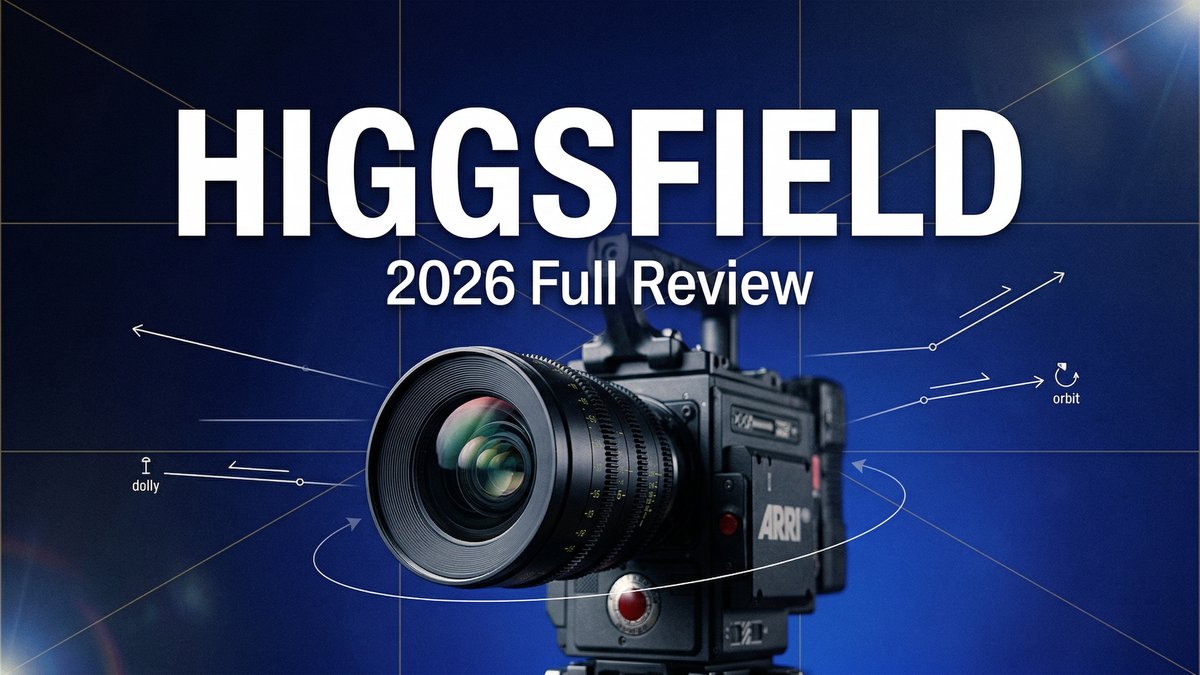
When it comes to Higgsfield Review 2026 pricing, while most AI video platforms lock you into a single proprietary model, Higgsfield AI takes a radically different approach: it aggregates 15+ leading AI video engines into one unified production studio. But the real game-changer isn’t just model variety—it’s Cinema Studio 2.0, a professional camera control system that simulates real optical physics.
After extensive testing and analysis of user reviews, this Higgsfield review reveals whether the multi-model cinema studio approach delivers genuine value for creators in 2026, and more importantly, whether it justifies the investment.
What Is Higgsfield AI?
Higgsfield AI is an all-in-one AI video and image platform that consolidates multiple leading AI models—including OpenAI Sora 2, Google Veo 3.1, Kling 3.0, Wan 2.5, Minimax, Seedance Pro, and proprietary models—into a single dashboard. Built for social media creators, agencies, and filmmakers, it eliminates the need for expensive gear or complex editing software.
What distinguishes Higgsfield from competitors is Cinema Studio 2.0, which simulates specific camera bodies (ARRI, RED, Sony), lens types including anamorphic glass, focal lengths, aperture settings, and depth of field. You can stack up to three simultaneous camera movements—combining a dolly zoom with a crane shot and an FPV sweep for genuinely complex sequences.
The platform also offers LipSync Studio for realistic talking-head videos, Video Upscale to 4K resolution, Soul ID for character consistency across scenes, and a library of 30+ visual effects from explosions to style transfers.
Core Features: What Makes Higgsfield Stand Out
Cinema Studio 2.0: Professional Camera Controls
Cinema Studio 2.0 is Higgsfield’s flagship feature and its primary differentiator. Unlike basic AI video generators that offer simple camera presets, Cinema Studio simulates real optical physics. You select virtual camera bodies, lens types (anamorphic, spherical, zoom), focal lengths, and depth of field settings—just like a real cinematographer.
The 70+ camera presets include Crash Zoom, Dolly Shot, 360° Orbit, Crane Movement, FPV Drone, Bullet Time, and more. These aren’t filters applied after generation—they’re baked into the AI’s understanding of how cameras move through space.
The 21:9 cinematic aspect ratio and 16-bit HD visuals deliver film-grade output. A hybrid workflow toggles between photography and videography modes without losing your seed or context, allowing you to iterate on stills and animate them seamlessly.
Multi-Model Access: 15+ AI Engines in One Platform
Higgsfield provides access to:
- OpenAI Sora 2: Narrative storytelling with emotional coherence
- Google Veo 3.1: Native audio generation with synchronized sound
- Kling 3.0: Photorealistic motion and extended clips
- Wan 2.5: Cinematography-focused with natural motion
- Minimax (Hailuo AI 2.0): High-texture prompt-based video
- Seedance Pro: Affordable cinematic with audio
- Runway Gen-3: Creative editing and film work
- Luma AI: Fast iteration and creative shots
Few platforms let you switch between top AI models in a single workspace. This multi-model approach means you pick the best engine for each project rather than settling for one. Veo 3.1’s native sound generation syncs audio directly to clips without third-party tools—a massive workflow advantage.
LipSync Studio: Realistic Talking-Head Videos
LipSync Studio accepts uploaded audio and generates realistic lip-sync animation on AI characters. The synchronization accuracy is impressive—mouths match words without the uncanny valley effect that plagued earlier AI avatar tools.
This feature is ideal for speech-to-video content, talking avatars, UGC ads, testimonial videos, and any content requiring a human presenter without filming actual people.
Soul ID: Character Consistency Across Scenes
One of AI video’s biggest challenges is maintaining consistent characters across multiple shots. Soul ID solves this by uploading 1-3 reference images of a character and keeping their face, outfit, and body type consistent across different scenes.
This is crucial for storytelling, branded videos, series content, or any project where the same character needs to appear multiple times. While it still requires multiple takes to perfect, Soul ID significantly reduces the randomness inherent in most AI video generation.
VFX Library and Video Enhancement Tools
Beyond generation, Higgsfield includes 30+ visual effects: explosions, style transfers (Ghibli anime, vintage film), face swap, skin enhancer, seamless transitions, and background removal. This is why Higgsfield Review 2026 pricing stands out in the market.
Video Upscale takes 720p footage to crisp 4K resolution, polishing quick generations for professional delivery. Scene-level editing tools allow you to swap styles, replace objects, or set first and last frame references to control output with precision.
Pricing: What You’ll Actually Pay in 2026
Higgsfield uses a credit-based pricing model. Monthly prices before the annual discount:
Free Plan – $0/month
- Limited daily credits
- Watermarked outputs
- Access to core models (restricted)
- Low resolution export
- 1 simultaneous task
Basic Plan – $15/month ($9/month annual)
- 150 credits per month
- Watermark removal
- Standard resolution output
- Access to core models
- Basic camera presets
- Community support
Pro Plan – $29/month ($17.40/month annual) – RECOMMENDED
- 600 credits per month
- HD resolution output
- All AI models unlocked
- Cinema Studio access
- Priority generation queue
- Commercial usage rights
Ultimate Plan – $49/month ($29.40/month annual)
- 1,200 credits per month
- 4K resolution output
- Concurrent processing (8 videos)
- Advanced editing suite
- Priority support
- Everything in Pro
Creator Plan – $249/month ($149.40/month annual)
- 6,000 credits per month
- API access
- Team collaboration features
- Custom models
- Dedicated account management
Annual Discount: Switching to annual billing provides a 40% discount across all paid plans. The Pro plan drops from $29/month to $17.40/month—a savings of $139 per year. The Creator plan saves nearly $1,200 annually.
Credit Consumption: Videos typically cost 20-50 credits based on model and length. Images range from 0.25-5 credits. More advanced models (Runway, high-res Kling) consume more credits per generation.
Pros and Cons: The Honest Assessment
What Works Exceptionally Well
Cinema-Grade Camera Controls: The 70+ camera presets and real optical physics simulation are unmatched by any competitor. You get shots that would require a crane, dolly track, and professional crew—without physical equipment.
Multi-Model Flexibility: Access to 15+ AI engines (Sora 2, Veo 3.1, Kling 3.0, Wan) in one workspace provides genuine creative flexibility. Pick the best model for each project rather than being locked into one engine.
Veo 3.1 Native Audio: Google’s Veo 3.1 integration generates video with synchronized audio, eliminating the need for separate sound design tools. This is a massive workflow time-saver.
LipSync Quality: The lip synchronization for talking-head videos is impressively accurate, avoiding the uncanny valley effect common in earlier AI avatar tools.
40% Annual Savings: The annual billing discount makes Higgsfield one of the most cost-effective multi-model platforms when billed yearly.
Active Development: Frequent model updates and new feature rollouts keep the platform current with the latest AI video technology.
Areas That Need Improvement
Aggressive Credit Burn: High-quality models and complex generations consume credits quickly. Heavy users may find themselves needing higher tiers or purchasing additional credits.
Character Consistency Limitations: While Soul ID improves character consistency, it still requires multiple takes to achieve perfect results across different scenes.
Interface Complexity: With so many tools and options available, the interface can feel overwhelming for newcomers. There’s a learning curve to master all features.
Clip Length Restrictions:Like most AI video platforms in 2026, output is capped at 10-20 seconds per generation. Longer content requires stitching multiple clips. This is why Higgsfield Review 2026 pricing stands out in the market.
No Batch Processing:You can’t queue multiple video generations for bulk creation, which would benefit high-volume creators. For more insights, see our Waymark AI Video Tool Review 2026: Script-to-TV-Ad in Minutes.
Email-Only Support: No live chat option means support queries go through email, which can be slower for urgent issues.
Competitor Comparison: Higgsfield vs. The Competition
Higgsfield vs. Runway ML
Runway excels in motion brush precision and frame-by-frame control, making it ideal for VFX artists and filmmakers who need granular editing. However, Runway locks you into one proprietary model (Gen-3 Alpha). Higgsfield offers 15+ models including Runway Gen-3, plus Cinema Studio’s advanced camera controls. Runway Standard costs $35/month vs. Higgsfield Pro at $17.40/month annual. Higgsfield wins on model variety and value; Runway wins on precision editing tools.
Higgsfield vs. Pika Labs
Pika specializes in fast generation for creative and social media content with limited camera controls. Pika costs $8-10/month but offers only its proprietary Pika 2.1 model. Higgsfield includes Pika AI as one of 15+ models, plus Cinema Studio controls that Pika lacks entirely. If you only need quick social clips and nothing else, Pika is cheaper. For professional cinematic work, Higgsfield is the clear winner.
Higgsfield vs. Pollo AI
Both platforms offer multi-model access, but with different strengths. Pollo AI focuses on reference-to-video consistency and viral effects library, ideal for social media creators. Higgsfield emphasizes Cinema Studio camera controls and professional filmmaking tools. Pollo AI credits don’t roll over monthly; Higgsfield’s approach is similar. Pricing is comparable ($15-29/month). Choose Pollo for social media effects and reference consistency; choose Higgsfield for cinematic camera work and professional production.
Real-World Use Cases: Who Should Use Higgsfield
Social Media Creators
TikTok, Instagram Reels, and YouTube Shorts creators benefit from Cinema Studio’s professional camera movements that make content stand out. The multi-model access allows testing different aesthetic approaches.
Marketing Teams and Agencies
Agencies creating ad variations, product videos, and social campaigns appreciate the multi-model flexibility for client work. The ability to switch between models based on brand requirements is valuable.
Independent Filmmakers
The Cinema Studio camera controls and cinematic aspect ratios make Higgsfield ideal for indie filmmakers exploring AI-assisted workflows, concept development, and storyboarding.
Budget-Conscious Creators
Creators who need professional-quality AI video but can’t afford $50-100/month in multiple subscriptions find strong value in Higgsfield’s annual pricing ($17.40/month for Pro).
NOT Ideal For:
Casual hobbyists who only need occasional videos (free tiers may suffice), creators requiring guaranteed frame-perfect consistency for client deliverables, or those needing extended video lengths beyond 20 seconds per generation.
User Experience: What the Community Says
Higgsfield holds a 3.7-star rating on Trustpilot, with over 15 million users worldwide. The mixed rating reflects growing pains as the platform scales rapidly.
Common praise centers on rendering speed (faster than many competitors), minimal learning curve for basic features, and genuinely high-quality output from premium models. The Cinema Studio camera controls receive particular acclaim from creators with filmmaking backgrounds.
Criticisms focus on billing practices and support responsiveness. Some users report difficulty obtaining refunds and support response times that fluctuate based on subscription tier. The credit system’s complexity (particularly around premium model consumption rates) creates budgeting challenges for some users.
The mobile app (Diffuse) receives positive reviews for feature parity with the web version, though older mobile devices experience slower generation due to browser limitations.
Expert Tips for Maximizing Higgsfield Value
Test Monthly Before Annual: Use 1-2 months of monthly billing to validate workflow fit before committing to annual discount pricing.
Match Models to Tasks: Use Wan 2.5 for cinematography, Kling for realistic motion, Veo 3.1 for audio-synced video, and Sora 2 for narrative storytelling. Each model has specific strengths.
Master Cinema Studio Gradually: Start with basic camera presets before diving into advanced optical physics settings. The learning curve pays off in output quality.
Leverage LipSync for UGC: The talking-head feature is ideal for testimonial-style ads and UGC content without hiring actors.
Monitor Credit Usage: Premium models burn credits quickly. Start with mid-tier models for concept testing, then generate finals with premium models.
Use Soul ID for Series: If producing content with recurring characters, invest time in perfecting Soul ID reference images upfront to save iterations later.
Final Verdict: Is Higgsfield Worth It in 2026?
Rating: 4.2 out of 5 stars
Higgsfield AI delivers exceptional value for creators serious about AI-powered video in 2026. The Cinema Studio 2.0 camera controls are genuinely best-in-class, offering professional cinematography tools no competitor currently matches. Multi-model access to 15+ engines provides creative flexibility that single-model platforms can’t offer.
The 40% annual discount transforms the pricing equation. At $17.40/month for the Pro plan, you get access to Sora 2, Veo 3.1, Kling 3.0, Runway Gen-3, and a dozen other models that would cost $200+ if subscribed to separately. That’s genuine value.
However, the credit system requires active management. Premium models consume credits aggressively, and the interface complexity can overwhelm newcomers. Character consistency via Soul ID is improved but still imperfect.
You should choose Higgsfield if:
- You need professional camera controls for cinematic content
- You regularly use or want access to multiple AI video models
- You’re willing to commit to annual billing for maximum savings
- You create content at volume and need model variety
- You value Cinema Studio’s unique capabilities over basic generation
Look elsewhere if:
- You only need occasional basic video generation (simpler tools suffice)
- You require frame-perfect consistency for client deliverables
- You need extended clip lengths beyond 20 seconds per generation
- You prefer simple interfaces over feature-rich complexity
For social media creators, marketing teams, and independent filmmakers who need cinematic-quality AI video without the cost of professional equipment, Higgsfield represents one of the strongest values in the 2026 AI video landscape. The learning curve exists, but the payoff in output quality and creative flexibility makes it worthwhile. For more insights, see our Best AI Video Tools for Product Demos in 2026: Showcase, Convert & Sell More.
Lock in the annual Pro plan at $17.40/month, master Cinema Studio gradually, and you’ll have a professional AI video studio at a fraction of traditional production costs.