The AI video generation landscape has evolved into two distinct categories. On one side are premium cloud-based platforms that prioritize ease of use, polished output, and integrated workflows. On the other are open-source models that offer greater customization, local deployment, and long-term cost control (For a deeper dive into how AI video pricing works across platforms, read our full breakdown of AI video pricing in 2026.).
Google Veo 3.1 and Alibaba’s Wan 2.2 represent these two approaches exceptionally well.
Veo 3.1 is Google’s flagship video generation platform, designed to produce high-quality video with native audio generation and seamless integration across Google’s AI ecosystem. Wan 2.2 takes a different approach, providing an open-source foundation that developers and technical users can deploy locally, customize, and integrate into their own workflows.
This comparison explores the strengths, limitations, and ideal use cases for each platform so you can determine which best fits your content creation or development needs.
Quick Comparison
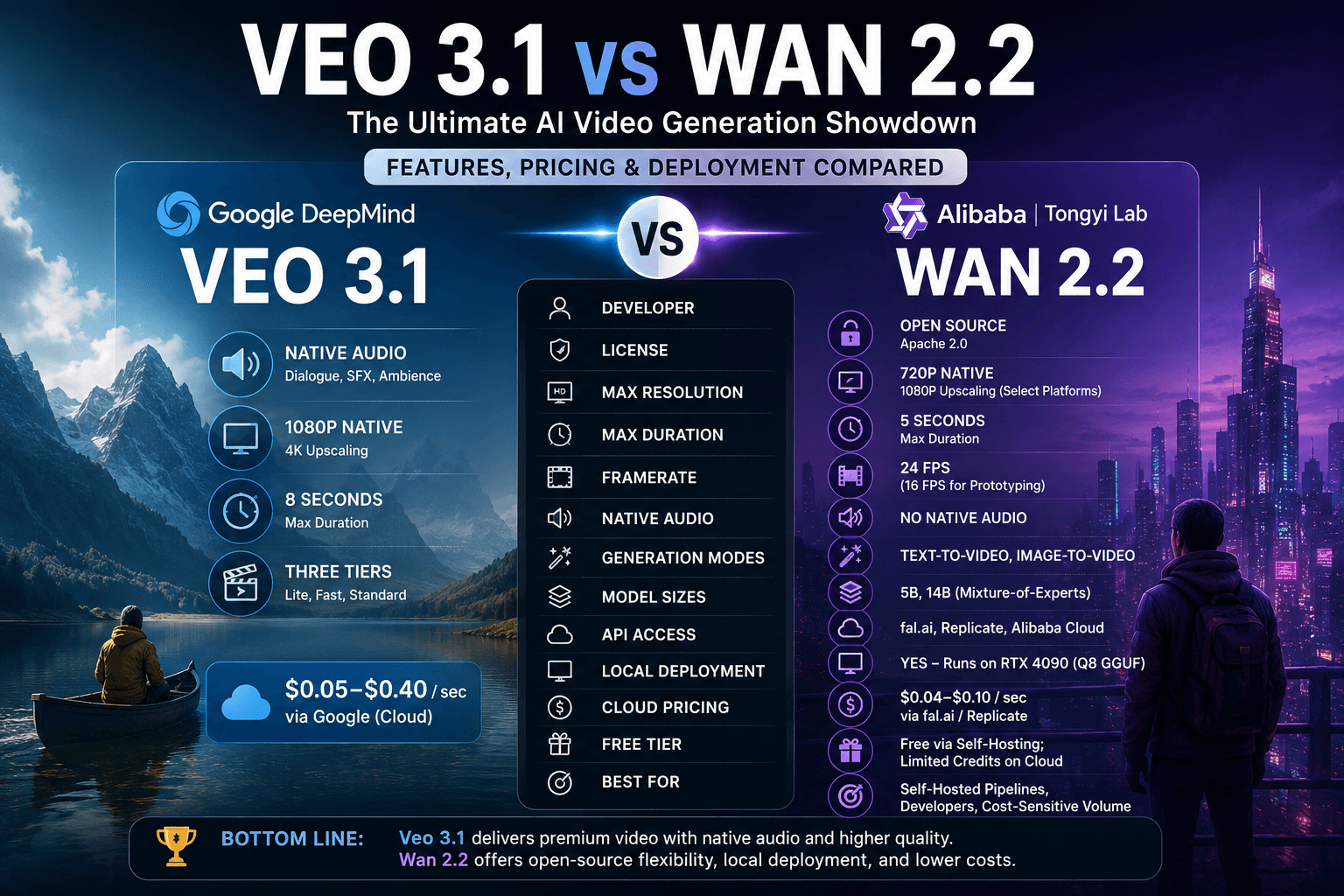
| Feature | Veo 3.1 | Wan 2.2 |
|---|---|---|
| Developer | Google DeepMind | Alibaba (Tongyi Lab) |
| License | Proprietary (Closed Source) | Apache 2.0 (Open Source) |
| Maximum Resolution | 1080p native with 4K upscaling options | 720p native with higher resolutions available through upscaling workflows |
| Maximum Clip Length | Up to 8 seconds | Up to 5 seconds |
| Native Audio Generation | Yes | No |
| Generation Modes | Text-to-Video, Image-to-Video, Video-to-Video | Text-to-Video, Image-to-Video |
| API Availability | Gemini API, Vertex AI, Google AI Studio | Alibaba Cloud, fal.ai, Replicate and community integrations |
| Local Deployment | No | Yes |
| Primary Strength | Quality, audio generation, ease of use | Flexibility, customization, local deployment |
| Best For | Creators, marketers, agencies | Developers, technical users, self-hosted workflows |
Google Veo 3.1: Built for Production-Ready Content
Veo 3.1 represents Google’s latest generation of AI video technology. The platform focuses on delivering high-quality video generation with integrated audio, making it particularly appealing for creators and businesses that want polished output with minimal post-production work.
Key Strengths
Native Audio Generation
One of Veo’s biggest differentiators is its ability to generate dialogue, sound effects, and ambient audio alongside video content. Instead of building separate visual and audio workflows, creators can generate both elements in a single process.
Multiple Performance Tiers
Google offers multiple Veo model variants designed for different use cases, ranging from rapid prototyping and social content creation to higher-quality production workflows.
Advanced Prompt Control
Veo supports detailed prompting techniques that help creators guide camera movement, scene composition, and timing. This level of control is particularly valuable for marketing videos and narrative content.
Integration with Google’s Ecosystem
Teams already using Google AI Studio, Vertex AI, Gemini, or other Google Cloud services can integrate Veo into existing workflows without introducing an entirely new technology stack.
Longer Clip Generation
With support for clips up to 8 seconds in length, Veo provides more storytelling flexibility per generation than many competing models.
Limitations
Cloud-Based Only
Veo is a proprietary service and does not support local deployment. All generation occurs through Google’s infrastructure.
Limited Customization
Because the model is closed source, users cannot modify model weights, fine-tune the system, or customize the underlying architecture.
Usage Costs
Pricing varies based on model tier, resolution, and access method. Organizations planning large-scale video generation should review current pricing directly through Google’s official documentation before committing to a workflow.
Wan 2.2: Open-Source Video Generation for Developers
Wan 2.2 has emerged as one of the most capable open-source AI video models available today. Its open architecture and local deployment options make it especially attractive for developers, researchers, and organizations seeking maximum flexibility.
Key Strengths
Open-Source Licensing
Wan 2.2 is released under the Apache 2.0 license, allowing users to download, modify, deploy, and integrate the model into custom applications and workflows.
Local Deployment
Unlike cloud-only platforms, Wan 2.2 can be deployed on high-end consumer hardware. Many users report successful deployments on RTX 4090-class GPUs using optimized configurations and quantized models.
Flexible Model Options
Different model variants allow users to balance performance, hardware requirements, and quality based on their specific needs.
Cost Control
Organizations generating large volumes of content may benefit from self-hosting, which can significantly reduce ongoing generation costs compared to per-second cloud billing models.
Growing Ecosystem
Wan 2.2 benefits from active community development, integrations with tools such as ComfyUI and Diffusers, and a growing collection of workflow extensions and fine-tuned models.
Limitations
No Native Audio
Wan 2.2 generates silent video. Users must create audio separately using voice generation tools, music generators, or traditional editing workflows.
Shorter Clip Lengths
The platform currently supports shorter clip durations than Veo, which may require stitching multiple clips together for longer scenes.
Higher Technical Complexity
While powerful, Wan 2.2 generally requires more technical knowledge than Veo. Local deployment, optimization, and workflow setup may involve a learning curve for non-technical users.
Hardware Requirements
Local deployment requires access to capable GPU hardware, particularly when working with larger model variants.
Head-to-Head Comparison
Video Quality
Advantage: Veo 3.1
In many public demonstrations and community comparisons, Veo 3.1 consistently delivers stronger photorealism, motion consistency, and prompt adherence. Wan 2.2 performs impressively for an open-source model, but Veo generally holds the edge in overall visual polish.
Audio Generation
Advantage: Veo 3.1
Veo includes native audio generation, while Wan 2.2 requires a separate audio workflow.
Customization
Advantage: Wan 2.2
Open-source access allows users to modify workflows, experiment with custom implementations, and build highly specialized video generation pipelines.
Cost Efficiency
Advantage: Wan 2.2
Organizations capable of self-hosting can dramatically reduce ongoing generation costs compared to cloud-only platforms.
Ease of Use
Advantage: Veo 3.1
Google’s ecosystem provides a more streamlined experience for creators who want high-quality results without managing infrastructure.
Local Deployment
Advantage: Wan 2.2
Wan 2.2 supports self-hosting and local execution, making it a strong option for privacy-sensitive environments and organizations seeking complete control over their data.
Who Should Choose Veo 3.1?
Veo 3.1 is an excellent choice if you:
-
Need native audio generation
-
Want the highest-quality output with minimal setup
-
Create marketing, advertising, or branded content
-
Prefer managed cloud services
-
Already use Google’s AI ecosystem
Who Should Choose Wan 2.2?
Wan 2.2 is a strong fit if you:
-
Want full control over your AI video workflow
-
Need local deployment capabilities
-
Generate large volumes of video content
-
Work in privacy-sensitive environments
-
Enjoy customizing and optimizing AI systems
Final Verdict
Choose Veo 3.1 if quality, native audio, and ease of use matter most.
Choose Wan 2.2 if flexibility, local deployment, and long-term cost control are your priorities.
These tools serve different audiences. Veo 3.1 is optimized for creators and businesses seeking polished, production-ready results, while Wan 2.2 appeals to developers, technical users, and organizations that want complete control over their AI video infrastructure.
Rather than competing directly, they represent two different visions of the future of AI video generation—one centered on convenience and quality, the other on openness and customization.