The Battle of AI Video Generation: Premium Polish vs Speed & Scale – Luma Dream Machine vs Haiper AI:
In 2026’s crowded AI video generation landscape, two platforms stand out for different reasons: Luma Dream Machine delivers cinema-grade quality with professional controls, while Haiper AI prioritizes lightning-fast generation and developer-friendly API access. Both are founded by former Google DeepMind researchers, yet they’ve taken distinctly different paths to solving the same problem: making AI video creation accessible and powerful.
If you’re a content creator, marketer, or developer trying to choose between these two platforms, this comprehensive comparison will help you make the right decision based on your specific needs, budget, and workflow For context on how pricing models compare across the entire AI video landscape, read our AI Video Pricing 2026 deep dive. requirements.
In this article, we will explore the features, benefits, and drawbacks of both platforms, providing you with the insights needed for your decision-making process regarding Luma Dream Machine vs Haiper AI:
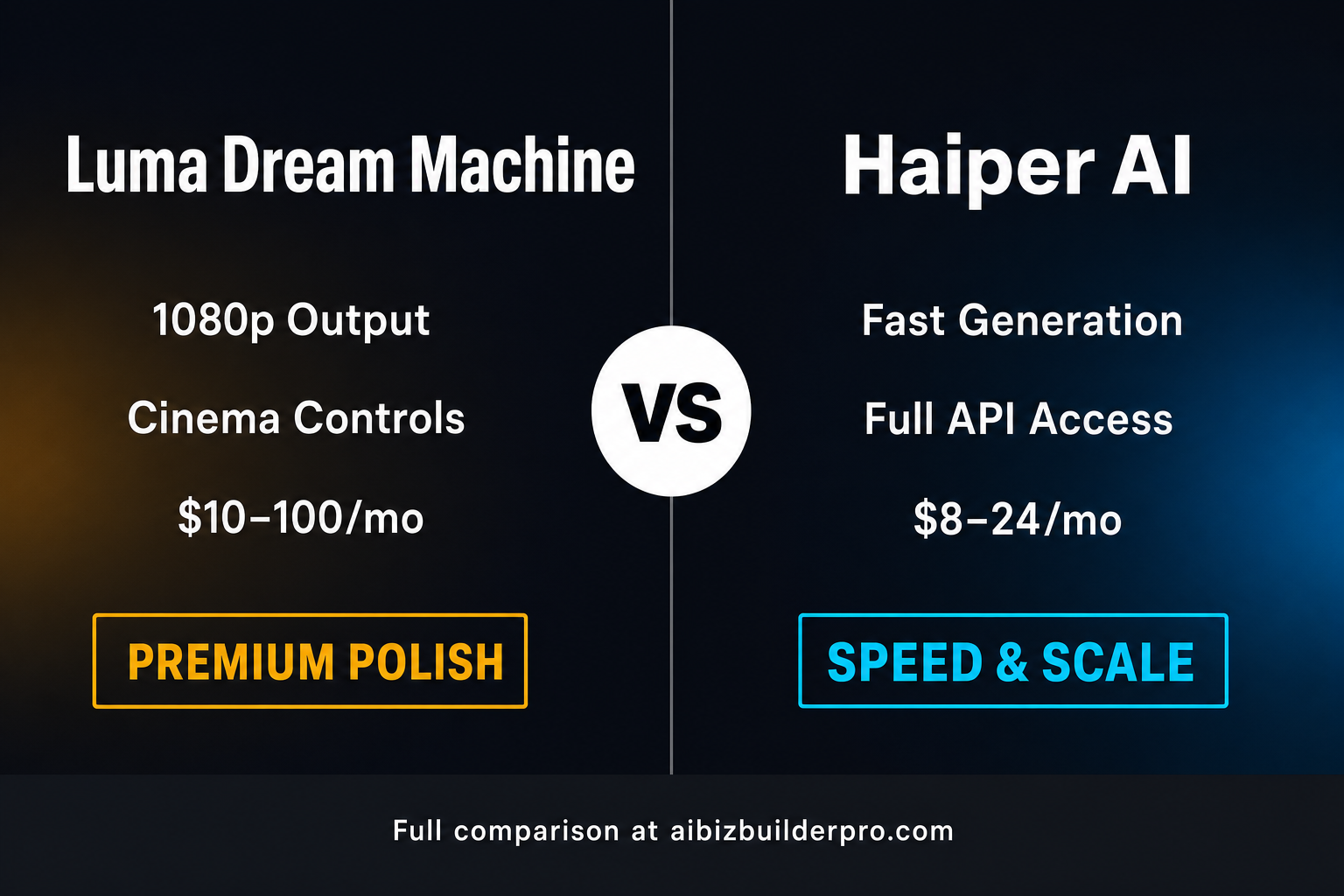
Quick Comparison Table
| Feature | Luma Dream Machine | Haiper AI |
|---|---|---|
| Max Resolution | 1080p (Full HD) | 720p (HD) |
| Generation Speed | 2-4 minutes per clip | 30-90 seconds per clip |
| Pricing (Monthly) | $10-$100/mo | $8-$24/mo |
| API Access | Limited (Enterprise tier) | Full API on all paid plans |
| Camera Controls | Advanced (pan, zoom, orbit, crane) | Basic prompt-based |
| Motion Consistency | Excellent (temporal coherence focus) | Good (some flickering on complex scenes) |
| Best For | Professional content, client work, cinematic projects | High-volume social content, rapid prototyping, automation |
Luma Dream Machine: The Premium Choice
What Makes Luma Stand Out
Luma Dream Machine built its reputation on one core promise: cinematic quality without compromise. The platform’s 1.6 and 2.0 models deliver some of the most visually stunning AI-generated video in the market, with particular strengths in:
- Motion realism: Smooth, natural movement with minimal artifacts or “AI jitter”
- Lighting and composition: Professional-grade cinematography that looks hand-directed
- Temporal consistency: Objects and characters maintain coherent appearance across frames
- Advanced camera controls: Precise pan, tilt, zoom, orbit, and crane movements via simple text commands
Luma Pricing Breakdown (2026)
- Free Tier: 30 generations/month, 720p output, watermarked
- Standard ($10/mo): 120 generations/month, 1080p output, no watermark
- Pro ($30/mo): 400 generations/month, priority queue, extended clips (10s)
- Premium ($100/mo): Unlimited generations, API access (limited), commercial license
Real-World Luma Use Cases
1. Brand marketing videos: Agencies use Luma to create polished product showcases and brand story videos where visual quality directly impacts client perception.
2. Concept visualization: Film and game studios leverage Luma’s camera controls to preview scenes and storyboard sequences before committing to full production.
3. Educational content: Course creators produce high-quality explanatory videos with smooth transitions and professional aesthetics that enhance credibility.
Luma’s Limitations
- Generation time: 2-4 minutes per clip makes it impractical for real-time workflows
- API restrictions: Full programmatic access only on expensive enterprise plans
- Cost at scale: Premium tier required for serious volume puts it out of reach for bootstrapped creators
Haiper AI: The Speed & Scale Champion
What Makes Haiper Stand Out
Haiper AI 2.0 took a different approach: optimize for throughput and developer experience. While it sacrifices some visual fidelity compared to Luma, it wins on:
- Generation speed: 30-90 seconds per clip, 3-5x faster than Luma
- API-first design: RESTful API with webhooks, batch processing, and comprehensive documentation
- Cost efficiency: Lower pricing tiers make high-volume generation economically viable
- Iteration velocity: Fast turnaround enables rapid A/B testing and creative experimentation
Haiper Pricing Breakdown (2026)
- Free Tier: 50 generations/month, 480p output, watermarked
- Creator ($8/mo): 200 generations/month, 720p output, API access
- Pro ($24/mo): 1,000 generations/month, priority processing, batch endpoints
- Enterprise (Custom): Unlimited, dedicated infrastructure, SLA guarantees
Real-World Haiper Use Cases
1. Social media automation: Marketing teams use Haiper’s API to auto-generate dozens of video variations for multi-platform campaigns, testing which versions drive engagement.
2. E-commerce product videos: Online retailers integrate Haiper into their CMS to automatically create product demo videos from static images and text descriptions.
3. News and content aggregation: Publishers generate timely visual content for breaking news stories where speed matters more than perfection.
Haiper’s Limitations
- Lower resolution ceiling: 720p max means it’s not suitable for large-screen playback or professional deliverables
- Less cinematic control: No granular camera movement controls; relies on prompt engineering
- Occasional quality inconsistency: Fast generation can produce flickering or morphing artifacts in complex scenes
Head-to-Head: Which Tool Wins for Your Workflow?
Choose Luma Dream Machine If:
- You’re creating client-facing work where visual quality is non-negotiable
- You need precise control over camera movements and cinematography
- You’re producing content for large screens (YouTube, presentations, ads)
- You value polish over speed and can wait 2-4 minutes per generation
- Your budget supports $30-100/month for premium tiers
Choose Haiper AI If:
- You’re running high-volume social media campaigns across multiple platforms
- You need to integrate video generation into automated workflows via API
- You’re iterating rapidly and need fast feedback loops (A/B testing, experimentation)
- You’re working on a tight budget and need cost-effective generation at scale
- Your output is primarily for mobile/web viewing where 720p is sufficient
The Hybrid Approach: Using Both Tools
Many professional content teams don’t pick one exclusively. Instead, they use both tools strategically:
- Luma for hero content: Main campaign videos, client presentations, portfolio pieces
- Haiper for volume work: Social media variants, quick turnaround requests, testing concepts
This hybrid workflow lets teams maintain quality where it counts while leveraging speed and cost savings for everything else.
Technical Considerations: Integration and Workflow
Luma Integration
Luma’s web interface is polished and intuitive, but programmatic access is limited. The platform prioritizes user experience over developer tooling, which makes it ideal for individual creators but challenging for teams building automated pipelines.
Haiper Integration
Haiper’s API documentation is comprehensive, with SDKs for Python, Node.js, and REST endpoints. Webhook support means you can trigger video generation from external events (new product uploads, scheduled campaigns, user requests) and receive callbacks when clips are ready.
The Verdict: Quality vs Velocity
The Luma vs Haiper decision isn’t about which tool is objectively better—it’s about which trade-offs align with your priorities:
Luma Dream Machine is the premium choice for creators who refuse to compromise on visual quality. If your work appears in client presentations, on large screens, or represents your brand to the world, Luma’s cinematic output justifies the higher price and slower generation.
Haiper AI is the pragmatic choice for teams optimizing for throughput, cost, and automation. If you’re generating hundreds of videos monthly, need API integration, or prioritize iteration speed over perfection, Haiper delivers exceptional value.
2026 Outlook: What’s Next
Both platforms are actively developing:
- Luma roadmap: Longer clip durations, improved character consistency, expanded API access
- Haiper roadmap: Resolution upgrades (1080p coming Q3 2026), advanced style controls, real-time preview
The gap between quality and speed is narrowing. By late 2026, we expect Haiper to offer 1080p output and Luma to reduce generation times significantly, making the choice less binary.
Final Recommendation
Start with your distribution channel and work backward:
- Instagram/TikTok/Facebook: Haiper’s 720p is plenty, and speed wins
- YouTube/LinkedIn/Client deliverables: Luma’s 1080p and polish matter
- Mixed use: Try both free tiers for a month, measure which drives better results
Both Luma Dream Machine and Haiper AI represent the cutting edge of accessible AI video generation. The “right” choice depends entirely on whether your workflow values premium polish or speed at scale—and in 2026, you no longer have to sacrifice everything to get either one.