AI Video News April 2026: Veo 3.1 Lite, Sora Shutdown, Wan 2.7, and UtopiaI PAI
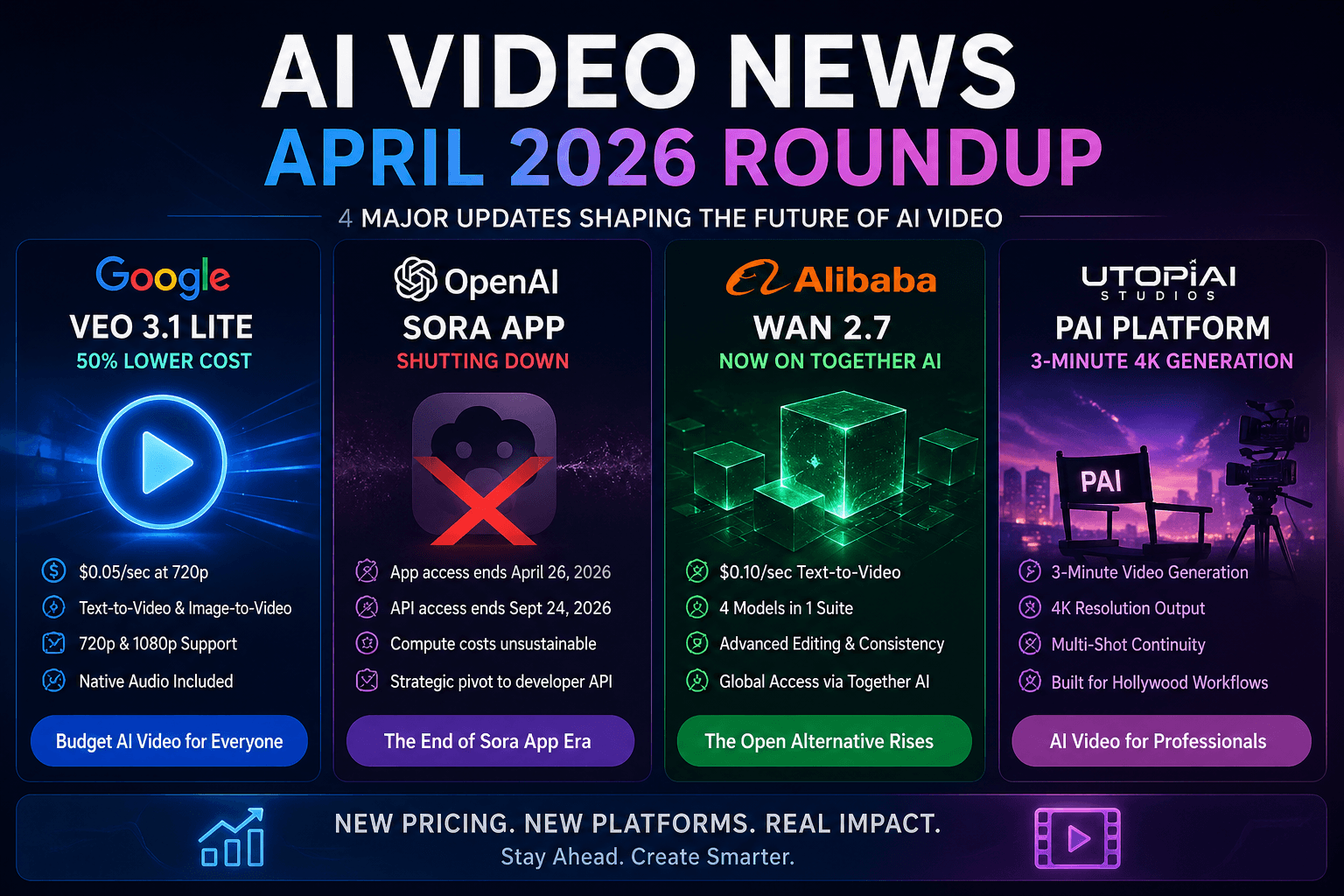
The AI video generation landscape transformed dramatically in April 2026. While some platforms pulled back, others accelerated with aggressive pricing and major technical breakthroughs.
If you’re creating video content with AI tools—or considering it—these four developments could reshape your workflow and budget in the months ahead.
1. Google Launches Veo 3.1 Lite: The Budget Play
Release date: April 1, 2026
Key stat: $0.05 per second at 720p (50% cheaper than Veo 3.1 Fast)
Google introduced Veo 3.1 Lite through Gemini API and Google AI Studio, positioning it as its most cost-effective AI video model for high-volume creators.
Pricing Breakdown
Model: Veo 3.1 Lite
720p: $0.05/sec
1080p: $0.08/sec
4K: Not supported
Model: Veo 3.1 Fast
720p: $0.10/sec
1080p: $0.12/sec
4K: $0.30/sec
A 10-second 720p clip that previously cost $1.50 now costs $0.50—a major reduction for creators producing content at scale.
Technical Capabilities
Veo 3.1 Lite supports text-to-video and image-to-video generation, 720p and 1080p output, both landscape and portrait formats, and clip durations of 4, 6, or 8 seconds. Native audio is also included.
The model matches Veo 3.1 Fast in speed while cutting compute costs significantly, making it viable for workflows like social media automation, e-learning, and rapid prototyping.
Strategic Context
Google’s timing is notable. The release came just days after OpenAI announced the shutdown of its Sora app. Rather than pulling back, Google doubled down by making AI video more accessible and affordable.
Use Cases
Veo 3.1 Lite is ideal for high-volume social content, course creation, marketing teams testing creative variations, and filmmakers prototyping scenes. While it lacks 4K, 1080p is sufficient for most digital-first content.
2. OpenAI Shuts Down Sora: The Economics Problem
Shutdown announced: March 24, 2026
Final access: April 26, 2026 (app), September 24, 2026 (API)
OpenAI’s decision to shut down the standalone Sora app highlights a key challenge in AI video: cost.
What Happened
Sora reportedly reached around 1 million peak users but dropped below 500,000 active users. The platform was burning approximately $1 million per day due to the high cost of video generation.
The issue wasn’t quality—it was usage. Many users created novelty content that didn’t justify the compute expense.
Strategic Shift
The Sora API remains available at $0.10 per second, signaling a pivot toward developers and enterprise use cases rather than consumer apps.
Industry Impact
Even major partnerships were affected. Disney, which had committed significant resources to Sora integration, reportedly learned about the shutdown shortly before it was announced publicly.
What Creators Should Do
Export content before the shutdown deadlines. Transition to alternatives like Veo, Runway, or Wan 2.7. Most importantly, avoid relying on consumer AI apps for mission-critical workflows.
3. Alibaba Wan 2.7 Goes Global via Together AI
Release window: April 3–6, 2026
Pricing: $0.10 per second
Alibaba’s Wan 2.7 suite is now globally accessible through Together AI, marking a major expansion for one of the strongest AI video systems in 2026.
The Wan 2.7 Ecosystem
Wan 2.7 includes text-to-video, image-to-video, reference-based generation, and AI video editing. This creates a unified workflow rather than requiring multiple tools.
Key Capabilities
The platform supports 720p and 1080p output, clip durations from 2 to 15 seconds, optional audio input, and multi-shot narrative control.
Its biggest advantage is continuity. Users can anchor frames, maintain character consistency, and edit videos using natural language without regenerating entire clips.
Competitive Position
At $0.10 per second, Wan 2.7 is competitively priced. However, its real strength lies in workflow efficiency, reducing friction in multi-step video production pipelines.
Access Points
Wan 2.7 is available through Together AI, Alibaba Cloud, Wan’s official platform, and third-party integrations like ComfyUI and creative apps.
Strategic Insight
Alibaba’s multi-platform distribution strategy contrasts with more closed ecosystems. By prioritizing accessibility, it’s aiming to win through adoption and developer ecosystem growth.
4. UtopiaI PAI Platform: The Hollywood Play
Announced: April 16, 2026
Key capability: 3-minute 4K AI video generation
UtopiaI Studios is targeting the professional filmmaking market with its PAI platform, focusing on long-form, high-quality video production.
Key Innovations
PAI supports 3-minute video generation, 4K resolution, multi-shot continuity, and iterative editing workflows. It also maintains character and scene consistency across longer narratives.
Professional Workflow
The platform spans pre-production, production, and post-production. It enables rapid prototyping, complex scene creation, and post-production refinement within a single system.
Narrative Continuity
PAI’s Story Agent is designed to maintain consistency across characters, environments, and cinematography—one of the biggest challenges in AI video today.
Clean Training Data
UtopiaI emphasizes that its models are not trained on copyrighted content, making it more suitable for commercial and studio use where legal clarity matters.
Pricing
While exact pricing isn’t public, the platform uses a transparent credit system where costs are shown before generation.
What This Means for Creators
The Market Is Splitting
Two clear segments are emerging:
Short-form, high-volume content driven by cost efficiency
Long-form, professional content driven by quality and continuity
Compute Costs Still Matter
The Sora shutdown demonstrates that consumer AI video apps are still economically unstable. Expect more platforms to shift toward API and enterprise models.
Pricing Pressure Is Increasing
Google’s aggressive pricing is forcing competitors to respond. Lower-cost, “good enough” solutions are becoming dominant for most use cases.
Open vs Closed Ecosystems
Alibaba’s open distribution strategy is creating strong momentum compared to more restricted platforms.
Recommended Actions
If you were using Sora, export content immediately and migrate workflows before deadlines.
If you’re evaluating tools, consider Veo 3.1 Lite for cost efficiency, Wan 2.7 for balanced workflows, and UtopiaI or Runway for high-end production.
If you’re building products, prioritize stable API platforms and avoid reliance on consumer-facing apps.
If you’re a filmmaker, monitor UtopiaI’s adoption and explore AI for pre-visualization workflows.
The Bigger Picture: Where AI Video Is Headed
2026 is shaping up as a consolidation year. Consumer apps are fading, while enterprise and developer-focused platforms are gaining traction.
Expect a handful of dominant platforms, more specialized tools, and increased consolidation across the industry.
The next major breakthrough will be reliable multi-minute video generation with consistent narrative continuity.
Final Thoughts
April 2026 marked a turning point for AI video. Pricing dropped, capabilities expanded, and the market began shifting toward sustainable business models.
For creators, the takeaway is clear: focus on tools that align with your workflow and scale. Test multiple platforms while competition is driving innovation and affordability.
AI video is no longer experimental. It’s becoming a core part of modern content production—and the platforms that survive will be those that solve real problems at realistic costs.
Sources
Google Veo 3.1 Lite announcement
CNET coverage of Google AI video updates
OpenAI Sora shutdown coverage (NPR, CNN, TechCrunch)
Alibaba Wan 2.7 updates via Together AI and industry blogs
UtopiaI Studios PAI platform announcement