PixVerse V6 vs HappyHorse 1.0: Which AI Video Generator Actually Delivers?
The AI video space just got its biggest shakeup of 2026. Two models launched within five weeks of each other — both claiming top spots on leaderboards, both promising cinematic output, both targeting professional creators. But they take fundamentally different approaches (Also check our Vidu Q3 vs Kling 2.6 comparison for another matchup between leading Chinese AI video tools.).
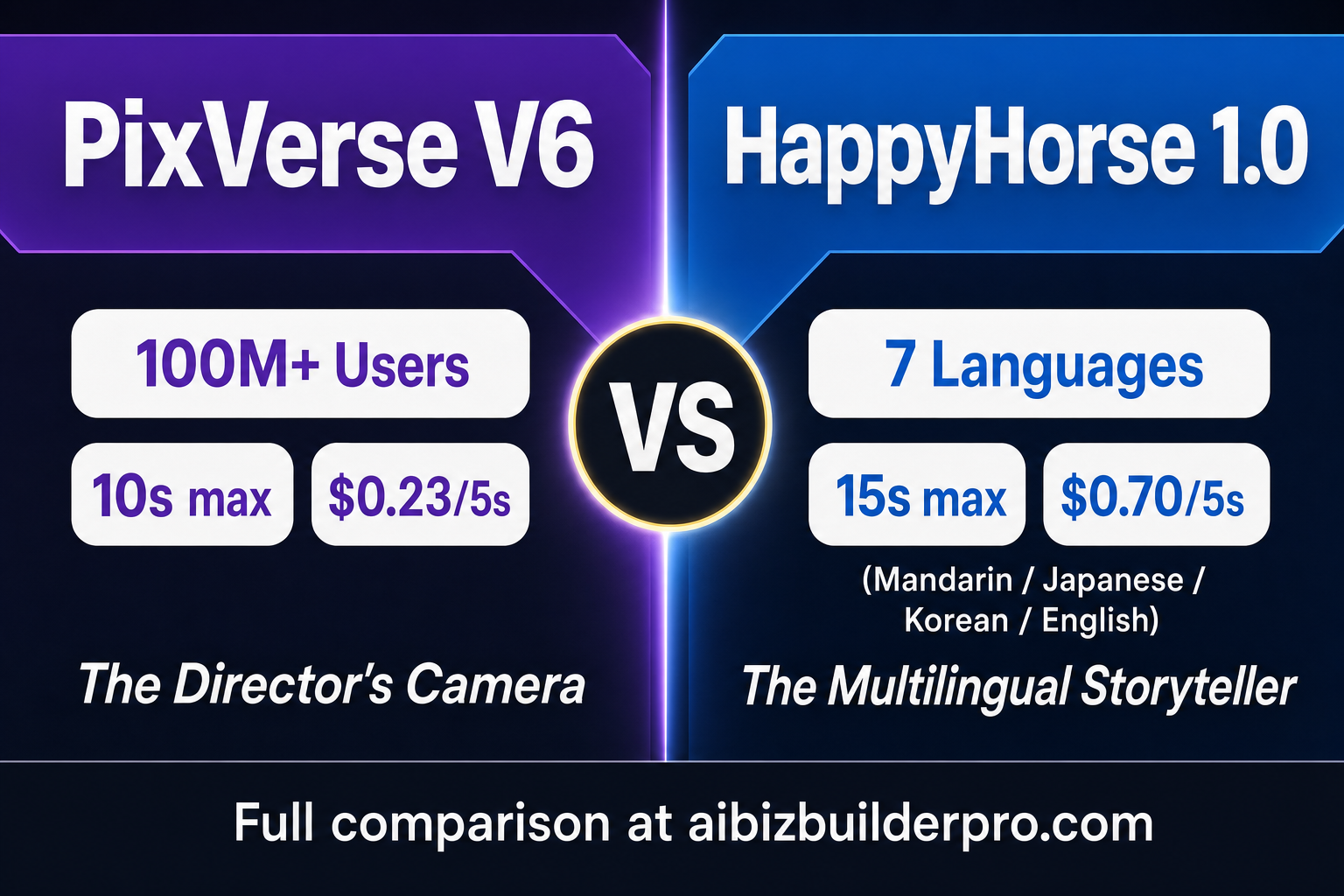
PixVerse V6 (March 30, 2026) is the latest from a company that’s already hit unicorn status with over 100 million users. It builds on V5.6 by adding a camera control system with over 20 cinematic lens controls — turning prompt-and-hope into a director’s toolkit.
HappyHorse 1.0 is Alibaba’s major entry into the video generation arena, developed by the Future Life Lab inside Alibaba’s Taotian Group. It appeared anonymously on the Artificial Analysis leaderboard on April 7, 2026, immediately climbing to #1, before Alibaba confirmed ownership on April 9–10. Developer API access via FAL went live April 27. Built on a unified single-stream transformer architecture, it’s designed for cinematic storytelling with joint audio-video generation in a single pass.
At a Glance: The Headline Numbers
| PixVerse V6 | HappyHorse 1.0 | |
|---|---|---|
| Official Launch | March 30, 2026 | April 7, 2026 (leaderboard); April 9–10 (Alibaba confirmed); April 27 (API live) |
| Availability | Public (web + API) | Limited beta (web + API) |
| Max Resolution | 1080p | 1080p |
| Max Clip Length | 15 seconds | 15 seconds |
| Starting Price (5s, 720p) | ~$0.23 | ~$0.70 |
| Native Audio | Yes | Yes (with Foley sounds) |
| Multi-Shot | Yes | Yes |
| Lip-Sync | Limited | Yes (7 languages) |
| Video Translation | Yes | No |
| Camera Controls | Advanced (20+ cinematic controls) | Basic |
| API Access | platform.pixverse.ai | FAL.ai, Alibaba Cloud, Replicate |
Where PixVerse V6 Wins
1. Cinematography Controls That Actually Work
V6’s headline feature is a camera system that gives you director-level control across more than 20 distinct cinematic options. You’re not just writing prompts — you’re choreographing shots.
Camera tracking lets you follow a subject through a scene with smooth, Hollywood-style tracking shots. Perspective shifts change the viewer’s vantage point mid-clip. Depth-of-field control directs attention through selective focus. Crane and dolly movements add sweeping vertical and horizontal motion. And lens-level controls — focal length, aperture, distortion, chromatic aberration, vignetting — go further than any comparable model currently offers.
In practice, this means you can generate a clip and specify: “Dolly left while tracking the subject, pull focus to the background at 3 seconds.” That’s a genuine creative input, not a hope-the-model-guesses-right lottery. For commercial work — product reveals, real estate walkthroughs, brand films — this is the difference between usable footage and wasted credits.
HappyHorse doesn’t compete here. Its camera control is basic — you’ll get a nice-looking shot, but you’re not directing it.
2. Lower Cost Per Second
On PixVerse’s platform, a 5-second 720p clip costs roughly $0.23. At 1080p, you’re looking at approximately $0.58 for a 5-second clip — around $0.04 per second at 720p by official pricing.
HappyHorse runs $0.14/second at 720p through FAL.ai — $0.70 for a 5-second clip. For high-volume creators generating dozens or hundreds of clips weekly, PixVerse is meaningfully cheaper.
3. Mature Platform With 100M+ Users
PixVerse didn’t appear overnight. V6 is the sixth major iteration of a model battle-tested by 100 million users across 175 countries. The API is stable. The documentation is solid. There are community workarounds for common problems. You’re not debugging a beta product.
4. Video Translation
PixVerse supports video translation — converting spoken content between languages while maintaining speaker identity and lip sync. This is a distinct feature from HappyHorse’s lip-sync generation and opens up repurposing existing content for new markets.
Where HappyHorse 1.0 Wins
1. Outright Quality — #1 on Blind Leaderboard
HappyHorse’s most significant achievement is objective: it holds the #1 Elo ranking on the Artificial Analysis Video Arena in both text-to-video and image-to-video (no audio) categories, based entirely on blind human preference votes where real users compare outputs without seeing model names. That’s a meaningful signal that’s hard to dismiss.
2. Lip-Sync Quality Across Seven Languages
HappyHorse includes a lip-sync engine covering seven languages — Mandarin Chinese, Cantonese, English, Japanese, Korean, German, and French — with natural mouth movements and voice generation synchronized to facial expressions and head movements. For brands producing content across these specific markets, this is a genuine advantage. PixVerse has basic lip-sync and dubbing support, but it’s not at the same level of synchronization quality.
3. Foley Sound Generation
HappyHorse generates synchronized Foley sounds — footsteps, door creaks, ambient noise, object interactions — jointly with the visual output in a single pass. Most AI video generators either produce silent clips or add generic background music. HappyHorse’s joint audio-visual synthesis makes output feel significantly more immersive without post-production.
4. Multi-Shot Narrative Coherence
HappyHorse’s single-stream transformer architecture processes the entire multi-shot sequence as one generation, meaning shots maintain visual continuity — consistent lighting, character appearance, and scene geometry across cuts. PixVerse handles multi-shot too, but our testing showed occasional drift in character appearance between shots, especially in longer sequences.
5. Stronger Semantic Understanding
HappyHorse demonstrates notably better instruction-following for complex, narrative prompts. “A woman walks through a rainy Tokyo street, pauses under an awning as a cat darts past, then continues walking while the camera pulls back to reveal the cityscape” — HappyHorse got the sequence right more consistently than PixVerse, which sometimes skipped elements or reordered them.
Clip Length: A Tie
Both models support clips up to 15 seconds at 1080p. This was previously a differentiator for HappyHorse in earlier reporting, but PixVerse V6 matches it. Neither has an edge here.
Image-to-Video: Both Strong, Different Strengths
Both models accept image inputs and generate video from them. PixVerse leans toward cinematic dramatization of still images — adding camera movement, lighting changes, and atmospheric effects. HappyHorse excels at animating faces in uploaded images with lip-sync and natural expression shifts. For product photography, PixVerse delivers more polished results. For talking-head content in its supported languages, HappyHorse is the clear pick.
API and Developer Experience
| PixVerse V6 | HappyHorse 1.0 | |
|---|---|---|
| API Endpoints | Direct at platform.pixverse.ai | FAL.ai, Alibaba Cloud Model Studio, Replicate |
| Documentation Quality | Good — detailed model/pricing pages | Adequate — provider-dependent |
| Web Interface | Full-featured creative platform | Qwen App (consumer) + HappyHorse site (beta) |
| SDK Support | REST API + CLI | FAL.ai SDK, Alibaba Cloud SDK |
| Rate Limits | Generous on paid tiers | Beta constraints — expect throttling |
PixVerse’s direct API is simpler to integrate if you’re building a single-provider pipeline. HappyHorse’s multi-provider availability means you can shop for the best latency and pricing, or build redundancy into your stack.
The Verdict: Which One Should You Use?
Choose PixVerse V6 if:
- You need precise camera direction (20+ cinematic controls including tracking, dolly, depth-of-field, lens distortion)
- Budget is a primary concern — costs are roughly 3x lower per second
- You want a stable, mature platform with full documentation
- Your workflow includes video translation across languages
- You’re producing commercial video: product showcases, real estate tours, brand spots
Choose HappyHorse 1.0 if:
- Raw output quality is your top priority — it’s the current #1 on blind human preference leaderboards
- Lip-sync across Mandarin, Cantonese, English, Japanese, Korean, German, or French is core to your workflow
- Foley sound generation would eliminate post-production steps
- Multi-shot narrative coherence is critical — you’re telling stories, not making clips
- You’re producing multilingual content in HappyHorse’s supported language markets
Use both if:
- You need camera-controlled product shots (PixVerse) AND lip-synced talking-head content in supported languages (HappyHorse)
- Your pipeline benefits from provider diversity
What Neither Does Well (Yet)
Long-form video: Both cap at 15 seconds. For anything longer, you’re stitching clips — and continuity is still an AI weak point.
Complex action sequences: Fighting, dancing, rapid motion — both models produce artifacts and limb-warping at higher intensities.
Text rendering: Neither reliably renders readable text in video (signs, labels, on-screen graphics). If you need text in-frame, plan on post-production overlays.
HappyHorse is still beta: Expect occasional outages, undocumented limitations, and API changes. PixVerse is production-ready.
Bottom Line
For most commercial creators, PixVerse V6 is the safer bet right now: cheaper, stable, with 20+ cinematic camera controls and a battle-tested platform. The cost advantage — roughly 3x cheaper per second at 720p — adds up fast at production scale.
But if output quality is your primary criterion, HappyHorse 1.0’s #1 blind-test ranking is hard to argue with. And if lip-synced content in its seven supported languages is your core workflow, it’s the clear choice. For global brands producing content specifically in Mandarin, Cantonese, English, Japanese, Korean, German, or French — that’s not a nice-to-have, it’s the whole workflow.
The real winner might be creators who use both: PixVerse for the cinematic b-roll and product shots, HappyHorse for the talking-head and lip-synced sequences. At current prices, that dual-provider stack costs less than what a single 5-second stock clip used to run — and that’s the story of AI video in 2026.
Sources: PixVerse official launch announcement (March 30, 2026); Alibaba/CNBC HappyHorse reveal (April 9–10, 2026); Artificial Analysis Video Arena leaderboard; FAL.ai HappyHorse API documentation; PixVerse Platform Docs — Model & Pricing; ReviewsTown HappyHorse 1.0 Review.